
Underground Pool Pipe Leak Detection in Coachella, CA
Water loss with no visible source often points to buried plumbing. We work out which line is leaking and where, so you know before anyone breaks ground.
Serving Coachella, CA and selected nearby communities.
Suspect a pool leak?
Tell us what you are seeing and we will help you work out where your pool is losing water.
(760) 388-1718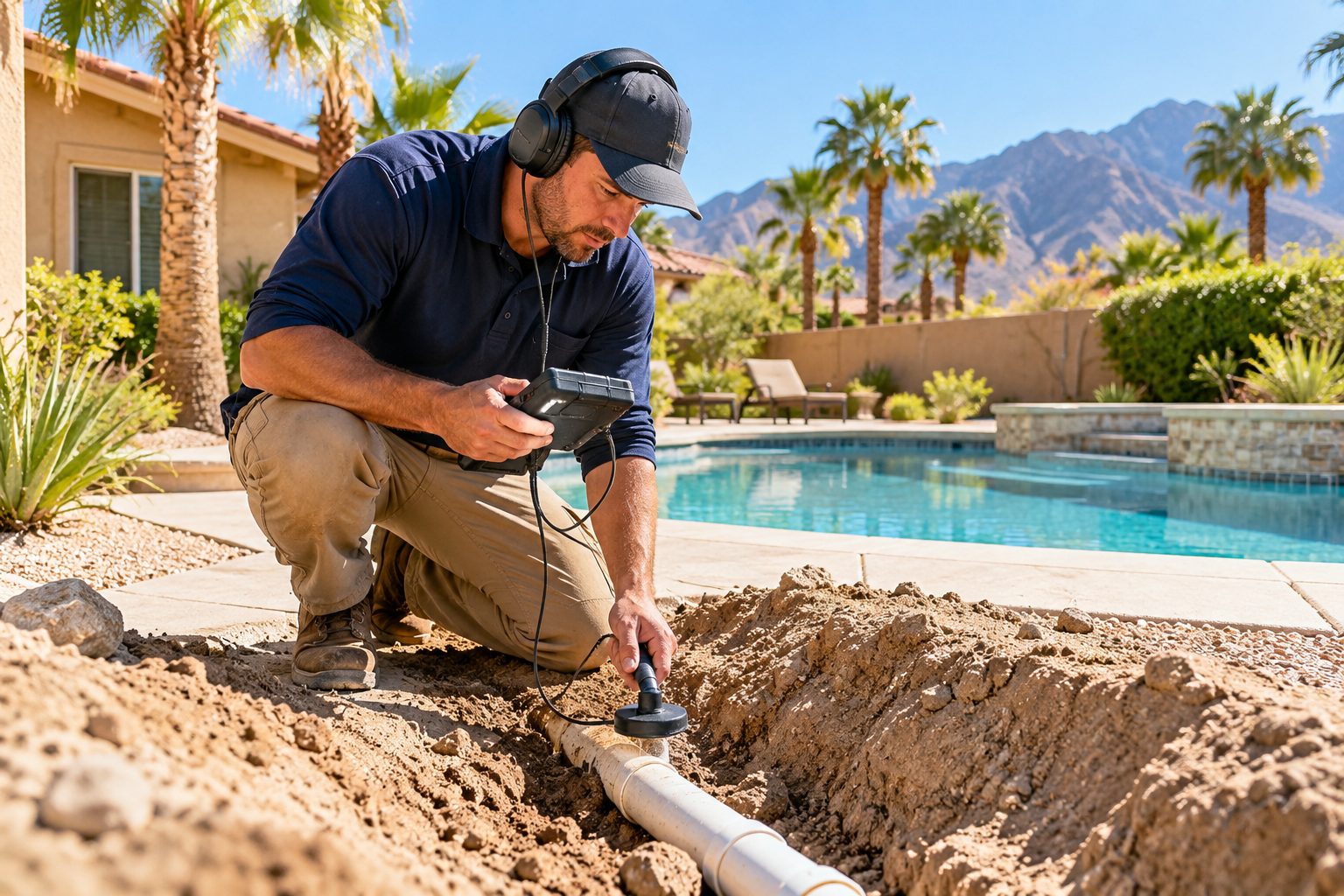
Overview
Finding leaks you can't see
Most pools have several runs of buried pipe: suction lines to the skimmer and main drain, return lines back to the pool, and lines feeding a heater, spa or water feature. A crack, a failed glue joint or a pulled fitting on any of them can leak for months without a wet spot at the surface.
Our job is to answer two questions before digging is ever discussed: which line is leaking, and where along that line. Getting that right first is what keeps excavation to a small area instead of a trench across your deck or yard.
If your pool loses water even when the equipment is off, or your pump loses prime and pulls in air, buried plumbing is one of the first places we check.
Signs of an underground leak
- Water level drops on a steady schedule, day and night
- Pump loses prime or the pump basket fills with air
- Soft, sunken or unusually green patches of yard near the pool
- Auto-fill running more often, or a higher water bill
- Cracked or shifted decking along a pipe run
How we test
How we test for underground leaks
We work from the simplest tests to the most specific, so time goes into narrowing the problem rather than searching everywhere.
Confirm the loss is real
We compare the pool's water loss against evaporation, and against a run with the pump on and off, to see when the loss speeds up.
Pressure test each line
We isolate and pressurize each suction and return line on its own. A line that cannot hold pressure is the one that is leaking.
Pinpoint the location
On the failed line we use electronic listening equipment and line tracing to locate the point of loss along the run.
Our process
Equipment and how long it takes
Depending on the pool, we use pressure-testing plugs and gauges, electronic leak-listening equipment, line-locating tools and dye. A typical underground pipe assessment takes roughly two to four hours, and longer for large properties or pools with several separate lines, since each line is tested individually.
We locate leaks; we do not perform the repair itself. An accurate location helps whoever you hire keep any digging small and targeted.
What you will know when we finish
- Whether the leak is in the buried plumbing at all, or somewhere else
- Which line is affected
- The approximate location along that line
- What further steps make sense, in plain language
Good to know
Why it is worth finding early
A buried leak does more than waste water. Water that keeps escaping into the ground can wash out the soil under decking and pool equipment, and it makes your pump work with more air and less flow than it should. It also keeps adding chemicals, heating costs and refill water to your bill. Because these leaks tend to grow, tracking one down early usually means a smaller area affected and a simpler conversation about what to do next. If you have noticed the level falling for more than a couple of weeks, it is worth testing rather than waiting.
Local conditions
Buried plumbing in the Coachella Valley
Coachella Valley yards often combine sandy, fast-draining soil with mature palms and landscaping. Roots and ground movement can stress buried lines, and in older pools the plumbing may have been installed to different standards over the years. Because sandy soil drains quickly, a leaking pipe does not always leave a wet patch at the surface, so a dry yard does not rule out a buried leak.
Questions
Underground leak questions
Do I have to dig up my deck to find the leak?
No. Locating the leak is done from the surface with pressure tests and listening equipment. Digging only comes up later, at the repair stage, and an exact location keeps it small.
How do you know the leak is underground and not in the shell?
By elimination. We test the pool at different equipment settings, then pressure test each line. If the lines hold pressure, we look at the pool structure and fittings instead.
Can more than one line be leaking?
Yes, which is why we test every line individually rather than stopping at the first failure.
Does the pool need to be drained?
Usually not for pipe testing. The pool generally stays full while we test the plumbing.
Related
Related services
Areas we serve
Need pool leak detection?
Ready to find your underground leak?
Call us to book a leak detection visit.