
Pool Return Line Leak Detection in Coachella, CA
Return lines carry filtered water back to the pool under pressure. When they leak, the water loss is often worse while the pump is running.
Serving Coachella, CA and selected nearby communities.
Suspect a pool leak?
Tell us what you are seeing and we will help you work out where your pool is losing water.
(760) 388-1718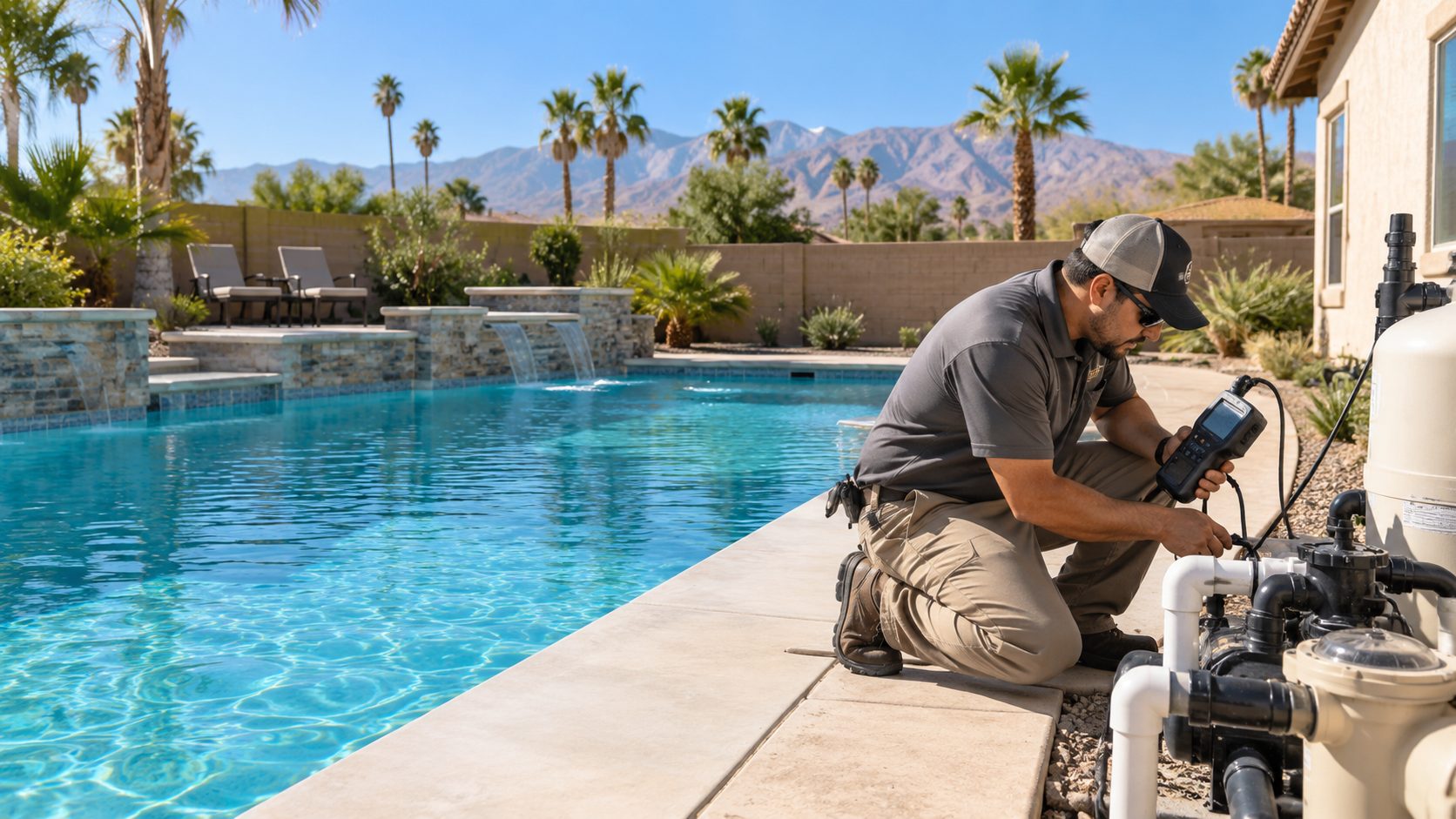
Overview
Leaks on the pressure side
The return side sends water from the filter and heater back through fittings in the pool wall. Because the water is under pressure, a small crack or loose joint can push water out only while the pump runs, which makes the loss look intermittent.
Return leaks can occur at the wall fittings, at buried joints and elbows, or at connections near the equipment pad. Heater and valve connections are also common trouble spots.
The pattern to watch: if the level drops faster while the pump is on than while it is off, the pressure side deserves attention.
Signs of a return line leak
- Water loss is faster with the pump on than off
- Wet or soft ground near the equipment pad, or between it and the pool
- Low reading on the filter pressure gauge, or weak return flow
- Reduced flow at the return jets
- Damp area or algae near the return fittings on the wall
How we test
How we test a return line
Comparing the pool with the pump on and off tells us quickly whether the pressure side is involved.
Compare pump on and off
We measure the level loss with the pump running and with it off, to confirm the pressure side is involved.
Pressure test the return line
We isolate the return line and pressure test it. A line that cannot hold pressure has a leak somewhere along its run.
Pinpoint the leak
We use listening equipment and line tracing to find the location, and check the wall fittings and equipment connections with dye.
Our process
Equipment and how long it takes
We use pressure-testing plugs and gauges, electronic listening equipment, line-locating tools and dye. Return line testing typically takes about one and a half to three hours, depending on how many return lines the pool has.
We locate leaks; we do not perform the repair itself. An accurate location helps whoever you hire keep any digging small and targeted.
What you will know when we finish
- Whether the pressure side is leaking, and which line
- The approximate location along the run, or the fitting at fault
- Whether the equipment connections are involved
- What further steps make sense
Good to know
Why return leaks are easy to miss
Return line leaks are easy to miss because they can look intermittent. The pool may seem fine overnight when the pump is off, then drop a little each day while the equipment runs. Many owners top up the water and assume the loss is evaporation, especially in summer. Comparing the loss with the pump on and off is one of the simplest ways to tell the difference, and you can start that comparison yourself by noting the level at the start and end of a pump cycle. If the loss follows the pump, tell us when you call, since it narrows the search. If pressure tests point away from the return side, we move on to the suction line and the main drain.
Local conditions
Sun-exposed equipment pads
Return plumbing in Coachella-area pools often runs under decks and hardscape between a side-yard equipment pad and the pool. Desert sun is hard on exposed pipe, unions and fittings at the pad, so we inspect the connections there as part of the visit.
Questions
Return line leak questions
Why does my pool only lose water when the pump runs?
Pressure from the pump pushes water out of a return-side crack or loose joint. When the pump is off, the pressure is gone and the loss slows or stops.
Can a return leak change my filter pressure reading?
It can. A drop in pressure or return flow can be a clue, though it can also come from other causes, so testing is what confirms it.
Can you find a leak under the deck?
We can locate the section of line involved from the surface. Whether the deck must be opened is decided afterward.
How is a return leak different from a suction leak?
Return leaks push water out under pressure, while suction leaks tend to pull air in. They call for different tests.
Related
Related services
Areas we serve
Need pool leak detection?
Ready to test your return line?
Call us to book a leak detection visit.